Assessment and Data Collection

Effective early literacy instruction in French Immersion programs requires consistent, reliable, and developmentally appropriate data. This section outlines the tools, processes, and structures that support screening, diagnostic assessment, and ongoing progress monitoring across Ontario’s French Immersion context. The goal is to ensure that educators have timely, actionable information to identify student needs, plan instruction, and intervene early.
Importantly, this work responds to evidence that streaming can occur in subtle and early ways, including placing students in special education settings without appropriate reading interventions or directing them out of French Immersion rather than providing the accommodations and supports needed for them to succeed within the program. Ensuring strong assessment and intervention practices in French Immersion is essential to preventing these inequities and supporting all students to remain and thrive (Ontario Human Rights Commission, 2022, p. 19).
This section is grounded in key provincial policy documents and research that emphasize equitable access to effective literacy instruction and the importance of early, evidence-based assessment practices in French Immersion contexts. It reflects a commitment to using data-informed approaches to support all learners and to prevent systemic barriers that can limit student success.
Specifically, this section aligns with:
- OHRC Right to Read Report (2022): Emphasizes the necessity of early screening, evidence-based instruction, and timely intervention to prevent reading difficulties and reduce inequities.
- Ontario Curriculum, French as a Second Language: Supports the development of oral language, reading, and writing through responsive instruction that is informed by ongoing assessment and reflects students’ developmental needs.
- A Framework for French as a Second Language in Ontario Schools, Kindergarten to Grade 12: Promotes inclusive, proficiency-oriented instruction and emphasizes the use of assessment to support student progress, engagement, and confidence in French-language learning environments.
- Including Students with Special Education Needs in French as a Second Language Programs: Highlights the importance of equitable access, appropriate accommodations, and targeted interventions to ensure students with special education needs can successfully participate and remain in FSL programs.
- Welcoming English Language Learners into French as a Second Language Programs: Supports inclusive practices that recognize multilingual learners’ strengths and underscores the need for responsive assessment and instruction to ensure equitable participation and achievement in French Immersion.
- CEFR Framework (Common European Framework of Reference for Languages): Reinforces the use of descriptive, competency-based approaches to language learning, where assessment is integrated, continuous, and used to guide next steps in instruction.
Together, these frameworks support a coherent and inclusive approach to literacy assessment and instruction that prioritizes early identification, responsive teaching, and equitable access to learning within French Immersion programs.
Oral language is foundational to student success in French Immersion. It underpins reading, writing, and social interaction, and is central to learning across all subject areas. The Ontario French as a Second Language (FSL) Curriculum places oral communication at the heart of language learning, recognizing that students develop proficiency in French through meaningful interaction, listening, and speaking experiences. In this context, oral language is both a key outcome and a primary vehicle for learning.
Consistent with Growing Success (2010), oral language assessment should be ongoing, varied, and integrated into daily instruction. Educators gather evidence of learning through conversations, observations, and student products, using this evidence to inform next steps and provide timely feedback. Assessment is not limited to formal tasks but embedded in authentic communication opportunities where students demonstrate their ability to understand and express meaning in French.
Oral language development cannot be assumed to occur naturally for all learners. Many students require intentional, explicit support to build the vocabulary, sentence structures, and confidence needed to communicate effectively. Without targeted opportunities and assessment, oral language needs may remain unnoticed, which can impact students’ academic achievement and social participation, particularly in French Immersion settings.
The Common European Framework of Reference for Languages (CEFR) provides a valuable structure for assessing and supporting language development. Tools such as CEFR “can-do” statements and samples of student work samples help make learning visible and support both assessment and goal setting. These descriptors promote an asset-based approach, allowing students and educators to clearly identify strengths, track progress, and determine next steps.
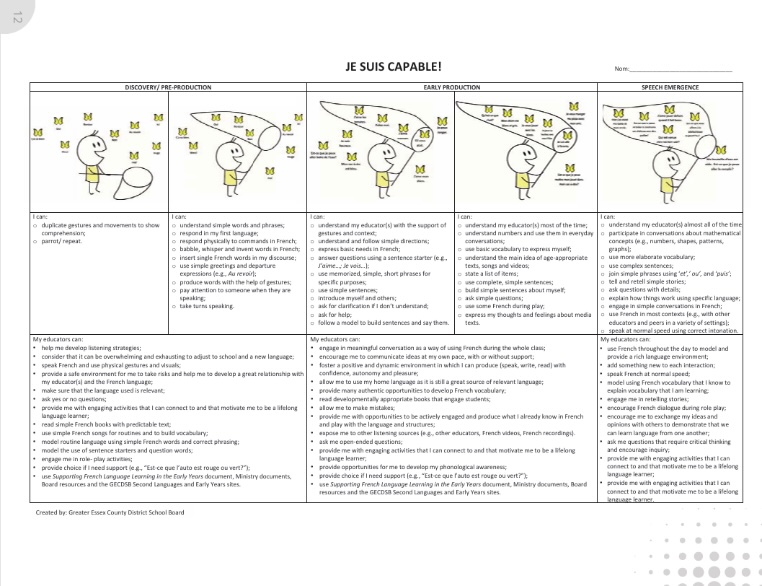 The continuum in Building Competent and Engaged Readers in French Immersion (p. 12) further supports educators in assessing early oral language development. It can be used as a self-assessment tool, particularly for beginning French as a Second Language learners, to help students reflect on their communication skills using accessible “I can” statements. Educators can also draw on the suggested strategies to scaffold language use and create inclusive, responsive learning environments.
For students beyond early proficiency levels, educators can use the full set of CEFR descriptors, including those adapted for young learners (ages 7–10), to ensure assessment remains developmentally appropriate and aligned with curriculum expectations. Together, these tools and frameworks support a comprehensive, equitable approach to oral language assessment in French Immersion.
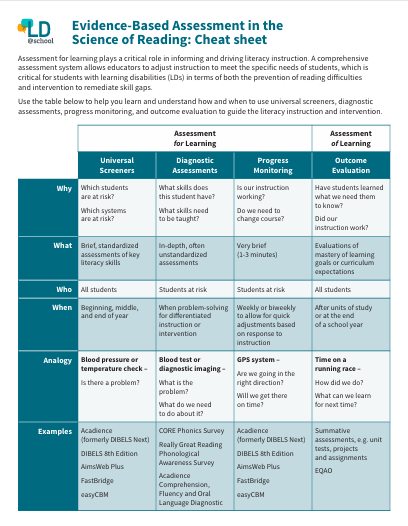
In a structured literacy approach, different types of assessment are used to answer distinct questions about student learning. Screening tools provide a quick indication of which students may be at risk, diagnostic assessments offer deeper insight into specific skill gaps, and progress monitoring tracks how students respond to instruction over time. While each serves a specific purpose, together they create a comprehensive view of student learning and inform responsive, effective instructional decisions.
Below is a helpful cheat sheet from the LD@School article, Evidence-Based Assessment in the Science of Reading (Malcolm, 2022), to support understanding of the purposes of various assessment tools:
“Early reading screening is designed to support effective instruction.”
-PPM 168
Universal screening tools provide early identification of students at risk for reading difficulties. They are brief, standardized, and administered at multiple points throughout the year.
The Ontario Ministry of Education of Ontario has approved the use of the following universal screeners:
When selecting and interpreting screening tools, it is essential to consider the specific context of your French Immersion program, such as the entry point and the proportion of instruction delivered in French. These factors influence students’ language exposure and development and therefore shape how screening data should be understood.
While benchmarks established for French as an additional language or English may appear ambitious in some program contexts, it is important to use the appropriate grade-level and time-of-year benchmarks to maintain consistency and accuracy. Rather than adjusting expectations, educators should interpret results thoughtfully, taking program context into account and focusing on patterns of growth over time. This ensures that decisions remain evidence-based while recognizing the unique pathways of language and literacy development in French Immersion.
It is equally important to support families in understanding this context. Clear communication with parents and caregivers about how screening works, why benchmarks are used, and how progress is interpreted in French Immersion helps build trust and shared understanding. Providing accessible explanations of student data and growth over time empowers families to be informed partners in supporting their child’s literacy development within the program.
View these videos from ONlit for more information about universal screeners: Screening: The Reel Deal or Le dépistage : l’essentiel pour les directions d’écoles”.
The Decision Tree from ONlit also provides valuable information for next steps for instruction and learning based on data collected. ONLIT decision tree (ENG) ONLIT decision tree (FR)
The Next STEPS in Literacy Instruction – Connecting Assessments to effective Interventions (Smartt & Glaser, 2024) book talks from ONlit also offer valuable information about using the Outcomes-Based Model to guide assessment and instruction. All the recordings, slide decks, and mentioned links are available for download from this link in English, and this link in French.
Additional Classroom-based Literacy Screening Tool:
- Test des habiletés fondamentales en littératie (THaFoL)– University of Toronto, Ontario Institute for Studies in Education (OISE) is an evidence-based assessment tool that is easily administered and interpreted by classroom teachers.
Diagnostic tools provide deeper insight into specific skill gaps. A diagnostic tool can be used in tandem with the chosen screener to gather more specific information about a student’s strengths and areas that require support.
ÉCLAIR is a research-based diagnostic assessment designed for French Immersion. This diagnostic assessment can be used in tandem with screening tools to determine students’ strengths and inform next steps for instruction. It includes:
- ÉCLAIR Guide (English & French)
- ÉCLAIR Assessment Booklets – Versions A, B & C – Each subtest has three versions that can be used at different points in the year. These versions have been tested and shown to be equally challenging, so results can be compared over time. You can use Version A in the fall, Version B in the winter, and Version C in the spring to track student progress. The testing has also shown that each subtest is reliable, meaning it consistently measures the same skills and students are expected to achieve similar results in repeated use.
- Student tracking spreadsheet (download a copy)
The sub-tests include:
Phonological Awareness Pre-A1 > A1
- Phoneme blending
- Initial sound isolation
- Final sound isolation
- Phoneme segmentation
Word Reading Pre-A1 > A2
- Letter naming Pre-A1 → A1
- Sound identification Pre-A1→ A1
- Word reading
- Simple orthography (1 letter = 1 sound/phoneme) A1
- Complex orthography (2 letters = 1 sound/phoneme) A1
- Complex orthography (3 letters = 1 sound/phoneme) A1
- Irregular words A1
- Nonsense word reading
- Simple orthography (1 letter = 1 sound/phoneme) A1
- Complex orthography (2 letters = 1 sound/phoneme) A1
- Complex orthography (3 letters = 1 sound/phoneme) A1
- Sentence reading A1 → A2
Examples of ÉCLAIR in Action
Below are some examples of how ÉCLAIR can be used in classroom settings. Note that implementation may vary depending on the specific context of your French Immersion program, including students’ entry point into the program and the proportion of instruction delivered in French.
Kindergarten Example
In addition to Acadience screening data, this Kindergarten educator team regularly uses the ÉCLAIR diagnostic assessment and tracking spreadsheet to inform targeted instruction in both whole-group and small-group settings. They also use the tracking spreadsheet to guide instructional decisions and determine appropriate progress-monitoring tools following small-group intervention.
Sample Kindergarten ÉCLAIR – Tracking Spreadsheet
Grade 2 Example
Based on mid-year Acadience Reading Français screening data, this Grade 2 teacher identified a need for more detailed information about the specific skills requiring additional support for one student. She therefore administered the ÉCLAIR diagnostic assessment.
For some students in her class, she begins with Skills 7 and 8 and then proceeds to Skills 1–6 if the students do not successfully complete the first cards in Skills 7 and 8. For this particular student, however, the teacher chose to administer the assessment components associated with Skills 1 through 8 in order to obtain a comprehensive profile of the student’s strengths and areas of need.
Results for this student – Version C
The student demonstrates strong phonological awareness and a solid understanding of single-letter grapheme-phoneme correspondences. Instruction should focus on complex grapheme-phoneme correspondences, orthographic mapping, accurate left-to-right decoding, automatic word recognition, and reading fluency in order to improve reading accuracy.
Grade 4 Example
This Grade 4 educator, in collaboration with the school’s Learning Support Teacher, used a “reverse ÉCLAIR” approach with Version A of the assessment to identify students who required further diagnostic assessment. For those students, Version B was then administered to determine which individuals might benefit from targeted small-group intervention.
Student A
Results of Reverse ÉCLAIR with Version A
Results of ÉCLAIR Version B
Student A: Analysis of results – Version B
Strengths
- The student demonstrates emerging phonological awareness skills, particularly in phoneme blending. The student is able to recognize many familiar words and use phonological knowledge to support some reading tasks.
Areas for Growth
- Phonemic awareness remains an area of need. While phoneme blending is relatively well developed, the student has greater difficulty segmenting words into individual phonemes, particularly when words contain three or more phonemes.
- Knowledge of letter names and letter-sound correspondences is not yet fully consolidated and at times affects accurate word analysis.
- The student often relies on whole-word recognition or familiar word patterns rather than complete decoding. This strategy can lead to substitutions or approximations, especially when reading unfamiliar or longer words.
- Reading accuracy decreases when words contain complex grapheme-phoneme correspondences or multiple syllables, and decoding of pseudowords remains challenging.
Instructional Focus
- Phoneme segmentation of words containing three or more phonemes.
- Consolidation of letter knowledge and grapheme-phoneme correspondences.
- Accurate left-to-right decoding and complete analysis of all graphemes within a word.
Student B
Results of Reverse ÉCLAIR with Version A
Results of ÉCLAIR Version B
Student B: Analysis of results – Version B
Strengths
- The student demonstrates strong foundational phonological awareness and a solid understanding of single-letter grapheme-phoneme correspondences.
Areas for growth
- The student relies on familiar word patterns when reading and does not consistently attend to all graphemes in longer words, particularly when graphemes have multiple letters.
- The student frequently omits, substitutes, or alters words when reading connected text, resulting in reduced reading accuracy.
Instructional Focus
- Multi-letter graphemes
- Orthographic mapping
- Accurate left-to-right decoding and word analysis
- Reading fluency through repeated reading and supported practice
Progress monitoring is a systematic process in which teachers administer brief, targeted reading assessments (typically 1–5 minutes) every 1–2 weeks, depending on intervention provided and student need. These assessments measure essential literacy skills such as phonemic awareness, decoding, fluency, and comprehension. The purpose is to capture real time data that reflects how well a student is responding to instruction.
Acadience Reading Français currently has the following progress monitoring tools available –
- Facilité à identifier le premier son
- Facilité à segmenter les phonèmes
- Facilité à lire les non-mots (niveaux M et 1)
Son-au-graphe has progress monitoring aligned to each lesson available at the back of the guide.
To progress monitor students beyond this point, repeated readings are recommended. For information about repeated reading, visit: Repeated Reading Implementation Guide | ONlit.org.
Additional Resources:
Q: What have you learned about the value of gathering data to better understand your students as learners?
Q: What data do you feel is important to gather in connection to word recognition?
Q: What is one strategy you use to support comprehension?
Q: How do you use the data that you gather to plan your next steps for instruction?
Q: In what way has your learning about assessment and structured literacy influenced your instruction?
Q: What has been the impact on student learning?
Q: What has helped you to be more confident about using data to guide your instruction?
Q: What advice would you give an educator just getting started with ÉCLAIR?
Q: What is the rest of the class doing while you are administering the assessment?